Buying guide
AR-15 Barrel Length and Twist Rate Guide
Compare Combat Armory's 7.5 inch and 16 inch AR-15 barrels, twist rates, gas system lengths, and what ships in a complete upper.
Updated · 5 min read
Two Numbers That Define an AR-15 Barrel
Every AR-15 barrel is defined first by its length and second by its rifling twist rate, written as a ratio like 1:7. Those two specs, together with the gas system length, determine how the rifle handles, what gas block or handguard length it needs, and to some extent what bullet weights it stabilizes well. Combat Armory’s AR-15 barrels and complete uppers list all three specs directly in the product bullets, so this guide sticks to what is documented on those listings.
Barrel Length: 7.5” Pistol vs. 16” Carbine
Combat Armory’s catalog includes complete AR-15 upper builds at two lengths:
| Length | Classification | Gas system | Example |
|---|---|---|---|
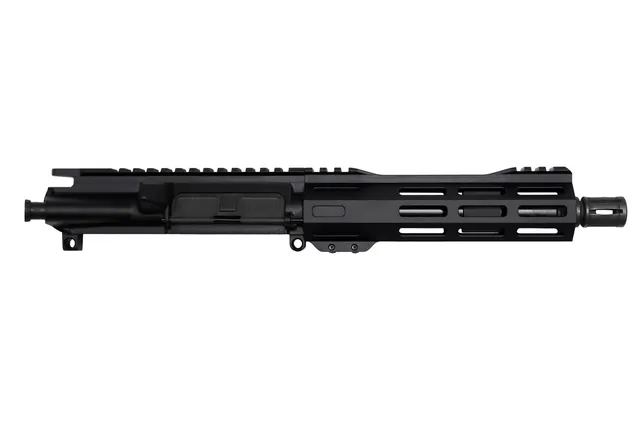
| 7.5” | Pistol length barrel | Carbine-length gas system on the complete builds | /combat-armory-ar-15-556-7-5-length-1-7-twist-w-7-slim-m-lok-handguard-no-assembly-required/ |
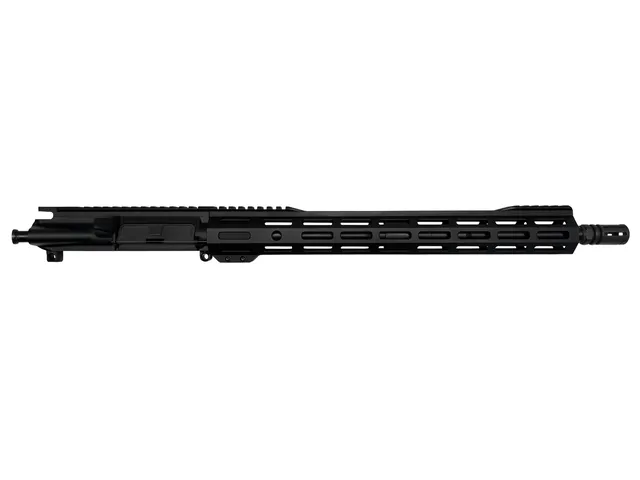
| 16” | Rifle-length barrel (meets standard rifle barrel length) | Carbine-length gas system | /combat-armory-ar-15-556-16-length-1-7-twist-w-15-slim-m-lok-handguard-no-assembly-required/ |
The 7.5” barrel is built into pistol-configuration uppers, paired with a shorter 7” slim M-LOK handguard on the base kit. The 16” barrel is the standard rifle-configuration length, paired with a 15” slim M-LOK handguard. Both lengths are offered in 5.56 NATO and in .300 BLK, and both 5.56 options ship with a 1:7 twist rate on the complete upper kits.
Shorter barrels reduce overall length and weight and typically reduce muzzle velocity somewhat compared to a longer barrel in the same caliber, since the bullet spends less time and distance under expanding gas pressure. Longer barrels add length and weight but typically add velocity. Neither length is inherently more accurate; barrel length choice is mainly about overall rifle length, handling, and intended use.
Twist Rate: 1:7 vs. 1:8 vs. 1:10
Twist rate describes how far the bullet travels down the bore for one full rotation of the rifling. A 1:7 twist means the rifling makes one complete turn every 7 inches. A tighter (lower number) twist spins the bullet faster for a given velocity, generally associated with stabilizing longer, heavier-for-caliber bullets; a slower (higher number) twist is generally associated with lighter bullets. This is general industry background, not a Combat Armory performance claim, and actual stabilization depends on the specific bullet, not caliber alone.
In the current catalog:
- The complete 5.56 and .300 BLK upper kits (both 7.5” and 16” versions) are built with a 1:7 twist rate.
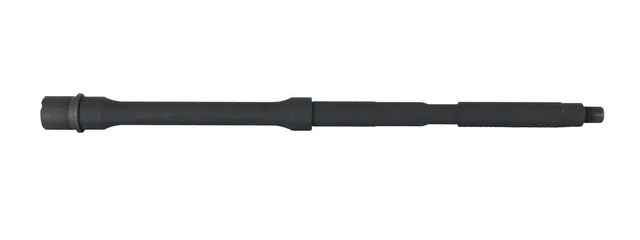
- The standalone 16” 4150 M4 contour barrel (carbine-length gas system) is listed under a 1:8 twist in its title.
- The AR-9 barrels (9mm) are listed with a 1:10 twist, paired with either a 1/2x28 or 1/2x36 thread pitch depending on the specific listing.
If you already know what bullet weights you plan to run, check the twist rate on the specific product page rather than assuming; twist rate is listed on a per-product basis and is not uniform across every barrel length or caliber in the catalog.
Gas System Length
Gas system length is a separate spec from barrel length, though the two are related. Combat Armory sells gas tubes individually in four standard lengths, each sold with a roll pin:
| Gas system | Gas tube length |
|---|---|
| Pistol length | 6.625” |
| Carbine length | 9.75” |
| Mid length | 11.75” |
| Rifle length | 15.125” |
The complete upper kits, including both the 7.5” and 16” builds, use a carbine-length gas system. A longer barrel does not automatically mean a longer gas system; gas system length is chosen based on where the gas port is drilled relative to the handguard, and Combat Armory’s complete kits standardize on carbine length across the current lineup.
Caliber: 5.56, .300 BLK, and 9mm (AR-9)
The catalog’s AR-platform barrels and uppers span three chamberings:
- 5.56 NATO: available in the 7.5” and 16” complete upper kits, and as a standalone 16” 4150 M4 contour barrel.
- .300 BLK: available in 7.5” and 16” complete upper kits, both listed with a 1:7 twist and paired with BCG and charging handle.
- 9mm (AR-9): a separate barrel line at 4.5” length, chambered in 9x19, with a 1:10 twist and a choice of 1/2x28 or 1/2x36 thread pitch, machined from 416 stainless steel.
Each caliber requires its own bolt and, for 9mm, a different magazine well configuration; these are not interchangeable by swapping the barrel alone.
What a Complete Upper Includes
Combat Armory’s complete AR-15 upper kits are listed as “no assembly required,” meaning the barrel, upper receiver, handguard, gas block, and related small parts arrive pre-assembled as a unit. Based on the listed specifications, the base kits include:
- Barrel (7.5” or 16”, 5.56 or .300 BLK, with listed thread pitch, twist, and gas system)
- Billet 7075 T6 upper receiver, M4 mil-spec pattern, Type III anodized
- Free-float M-LOK handguard (length matched to barrel length)
- Low-profile .750 gas block
- Forward assist and dust cover
- A muzzle device (A2 flash hider on the standard 5.56 kits)
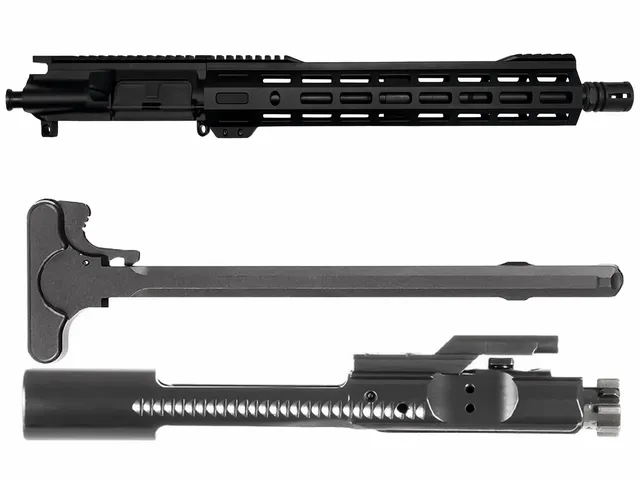
Several kits are also offered as a combo with a bolt carrier group and charging handle included, which is worth checking on the specific product page since not every listed kit includes those parts by default. Browse current builds on the /upper-assembly-kits/ category page, or the general /barrel/ category for standalone barrels.
Have any AR-15 build checked by a qualified gunsmith if you are assembling or headspacing it yourself, and check federal, state and local law before ordering, since barrel length and configuration rules vary by jurisdiction.
FAQ
Is a 1:7 twist better than a 1:8 for 5.56?
Neither is universally “better.” A 1:7 twist stabilizes a wider range of bullet weights, including heavier ones, while a 1:8 is a middle-ground rate common on 5.56 barrels generally. Which one suits you depends on what ammunition you plan to shoot; this guide does not make a performance ranking beyond what is listed on each product page.
Do the 7.5” and 16” complete uppers use the same gas system length?
Yes, based on the current listings, both the 7.5” and 16” complete upper kits in the catalog use a carbine-length gas system, not a pistol-length or rifle-length system.
Can I put a 9mm AR-9 barrel on any AR-15 lower?
No. The AR-9 barrel is chambered for 9x19 and is built around a different bolt and magazine well arrangement than a 5.56 or .300 BLK AR-15. Confirm your lower and BCG are configured for the AR-9 platform before ordering an AR-9 barrel.