Buying guide
Glock Barrel Thread Pitch Guide
A plain guide to Glock threaded barrel pitches, which calibers use which pitch, thread protectors, and what to check before mounting accessories.
Updated · 4 min read
Why Thread Pitch Is the Number That Matters
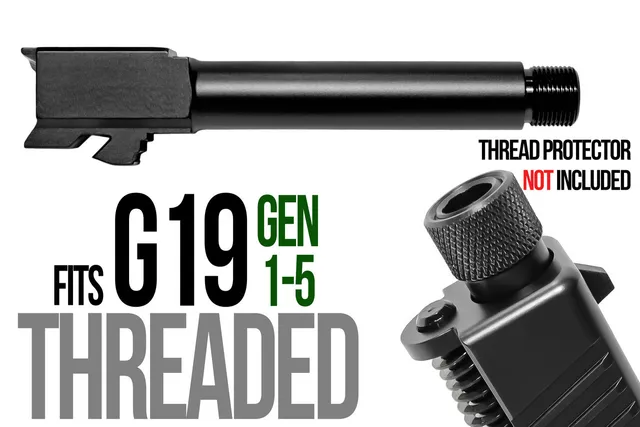
A threaded barrel lets you mount a compensator, suppressor, or thread protector to the muzzle. The thread pitch is the specification that determines whether that accessory will actually thread on. Two barrels can be the same length and caliber and still use different thread pitches, so pitch has to be checked independently of caliber and model.
Thread pitch is written as two numbers, such as 1/2x28. The first number is the outer diameter of the threaded section in inches, and the second is the number of threads per inch. Both numbers have to match between the barrel and whatever you are threading onto it.
Pitches Used on Combat Armory Threaded Barrels
Combat Armory’s Glock threaded barrels are cut to industry-standard pitches based on caliber:
| Caliber | Thread pitch | Example listing |
|---|---|---|
| 9mm | 1/2x28 | /combat-armory-barrel-fits-glock-19-new-9mm-match-grade-barrel-threaded/ |
| .45 ACP | .578x28 | /combat-armory-barrel-fits-glock-21-gen-3-4-45acp-barrel-threaded-578-x-28/ |
The 9mm barrels in the catalog, including the Glock 19 and Glock 17 threaded models, are cut to 1/2x28. This is the same pitch commonly used on .357 SIG threaded barrels, which is why Combat Armory’s thread protector is listed as fitting “1/2 x 28 (9mm & .357SIG Barrel).” The .45 ACP threaded barrel, built for the Glock 21, is cut to .578x28.
These same two pitches show up widely across the handgun and rifle-caliber pistol market: 1/2x28 is also the standard pitch on most 5.56 AR-15 barrels, and .578x28 is the pitch commonly used on .40 S&W threaded barrels industry-wide, in addition to .45 ACP. A different pitch entirely, 5/8x24, is the common industry standard for .308-caliber rifle barrels; Combat Armory’s current barrel lineup does not include a .308 threaded barrel, so if you need that caliber, confirm pitch directly with whatever .308 barrel you are sourcing.
Thread Pitch on the AR-15 Side
Combat Armory’s AR-15 barrels and complete upper kits are also cut to 1/2x28. The 16” and 7.5” 5.56 complete upper assemblies list “Muzzle Thread: 1/2x28” in their specifications, and the standalone 16” 4150 M4 contour barrel lists “Thread Pitch 1/2 x 28” as well. That means the same class of muzzle devices, thread protectors, and (where legally applicable) suppressors sized for 1/2x28 will thread onto both the 9mm Glock barrels and the 5.56 AR-15 barrels in the catalog, though the bore diameter and gas system are obviously not interchangeable between the two platforms.
Thread Protectors
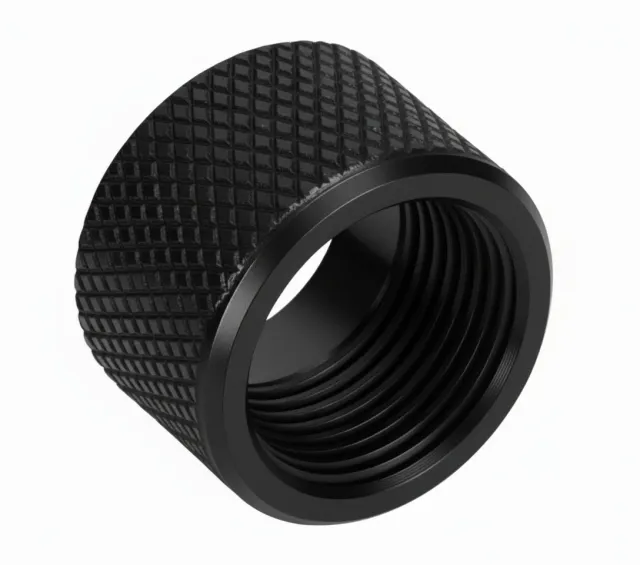
A thread protector is a plain, unthreaded cap that screws over exposed muzzle threads to keep them clean and undamaged when no muzzle device is mounted. Combat Armory sells a knurled thread protector cut for 1/2x28, sized for 9mm and .357 SIG threaded barrels, in black. If your barrel is threaded and you are not running a muzzle device full time, a thread protector is worth keeping on hand between range trips.
Thread protectors are matched by pitch, not by caliber alone, so confirm the 1/2x28 spec against your barrel before ordering rather than assuming caliber alone is enough. You can browse the current selection on the /thread-protector/ category page.
Suppressor and Compensator Fitment Notes
A few practical points apply regardless of which accessory you are threading on:
- Pitch has to match exactly. 1/2x28 hardware will not thread onto a .578x28 barrel, or the reverse, without an adapter, and adapters introduce their own alignment and torque considerations.
- Thread engagement length and shoulder design matter. Some muzzle devices index against a shoulder cut into the barrel; others rely purely on thread friction and a locking mechanism. Read the muzzle device’s own instructions for how it is meant to seat.
- A compensator or muzzle brake changes the balance and length of the pistol or rifle, which can affect holster fit on a handgun or handguard clearance on an AR-15. Measure before you buy a holster or handguard to match.
- If you are adding a suppressor, that is a regulated item under federal law with its own transfer process, separate from the barrel itself. Combat Armory ships serialized items to an FFL; check the /ffl-transfers/ page for how that process works.
Check federal, state and local law before ordering any threaded barrel or muzzle device, since rules on threading, muzzle devices, and suppressor-ready parts vary by jurisdiction.
Verifying Pitch Before You Buy
- Check the product page’s bullet list or description for the thread pitch, written as two numbers separated by an “x” (for example 1/2x28).
- Match that pitch against the accessory’s own listed thread spec, not just its caliber or the “fits Glock” language some third-party accessories use loosely.
- If you already own a muzzle device and are unsure of its pitch, a thread pitch gauge or a known-fit test part is the reliable way to confirm it rather than guessing from caliber.
- Have any threading or muzzle device installation checked by a qualified gunsmith if you are not confident doing it yourself, particularly around torque and shoulder alignment.
FAQ
Is 1/2x28 the same on a Glock 19 barrel and an AR-15 barrel?
Yes, as a thread specification. Both Combat Armory’s 9mm Glock barrels and its 5.56 AR-15 barrels and upper kits use 1/2x28 muzzle threads, so a 1/2x28 thread protector or compatible muzzle device will physically thread onto either, though the two platforms are not otherwise interchangeable.
What pitch does the Glock 21 .45 ACP barrel use?
.578x28. This is a different pitch from the 1/2x28 used on the catalog’s 9mm barrels, so 9mm-pitch accessories will not thread onto the .45 ACP barrel.
Does Combat Armory sell a thread protector for .578x28 barrels?
The current thread protector listing is cut for 1/2x28 (9mm and .357 SIG). Confirm current stock on the /thread-protector/ category page before assuming a .578x28 option is available.